* Equal contribution ✉ Corresponding author: soumiks@iastate.edu


Crop disease diagnosis is critical for food security, yet labeled disease images are limited and models trained on curated images generalize poorly to field images. We showed in AgEval that general-purpose vision-language models (VLMs) adapt to plant stress tasks from a few annotated examples, and we gave frozen VLMs source-grounded symptom knowledge for 335 crops in SAGE. Building on both studies, we introduce MACE (Memory-Augmented Crop-Disease Evaluation), a training-free method that adds a caption memory to SAGE. Each labeled reference image is described once as text, and the four most relevant labeled captions are retrieved for each test image. We evaluate MACE against label lookup on ten crops and 1,600 queries with two frozen diagnosis VLMs that share Sonnet-written captions, Claude Sonnet 5.5 and Claude Haiku 5.5, with near-copies removed and one image collection held out per crop. With four memory images per disease, MACE reaches 62.2% accuracy in distribution and 57.0% on held-out collections with Sonnet, and 55.5% and 53.5% with Haiku. SAGE reaches 42.8% and 50.7% with Sonnet (MACE gain +19.4 and +6.3 points) and 37.0% and 42.5% with Haiku (+18.5 and +11.0). Nearest-neighbor label lookup with DINOv2 reaches 52.5% and 38.2%, so Haiku with MACE does not clearly exceed it in distribution. With both models, retrieved labels account for about two thirds of the gain and caption text adds 6.4 points in distribution in post hoc tests. The strongest gain is in distribution, and the held-out gain depends on the source: it is 0.0 with Sonnet and +6.4 with Haiku on the seven crops that hold out Bugwood, and +21.1 and +21.7 on the three crops that hold out other collections. The held-out evidence is therefore source-specific. With both models, MACE falls below SAGE when the true disease is not retrieved, and a retrieval-confidence fallback did not improve accuracy. With Sonnet, MACE adds $0.0014 per query over SAGE and, at about one fifth of the price, reaches higher accuracy than an agent reading the same captions.

In AgEval, we showed that general-purpose VLMs adapt to plant stress tasks from a few annotated examples. In SAGE, we gave frozen VLMs source-grounded symptom knowledge for 335 crops.
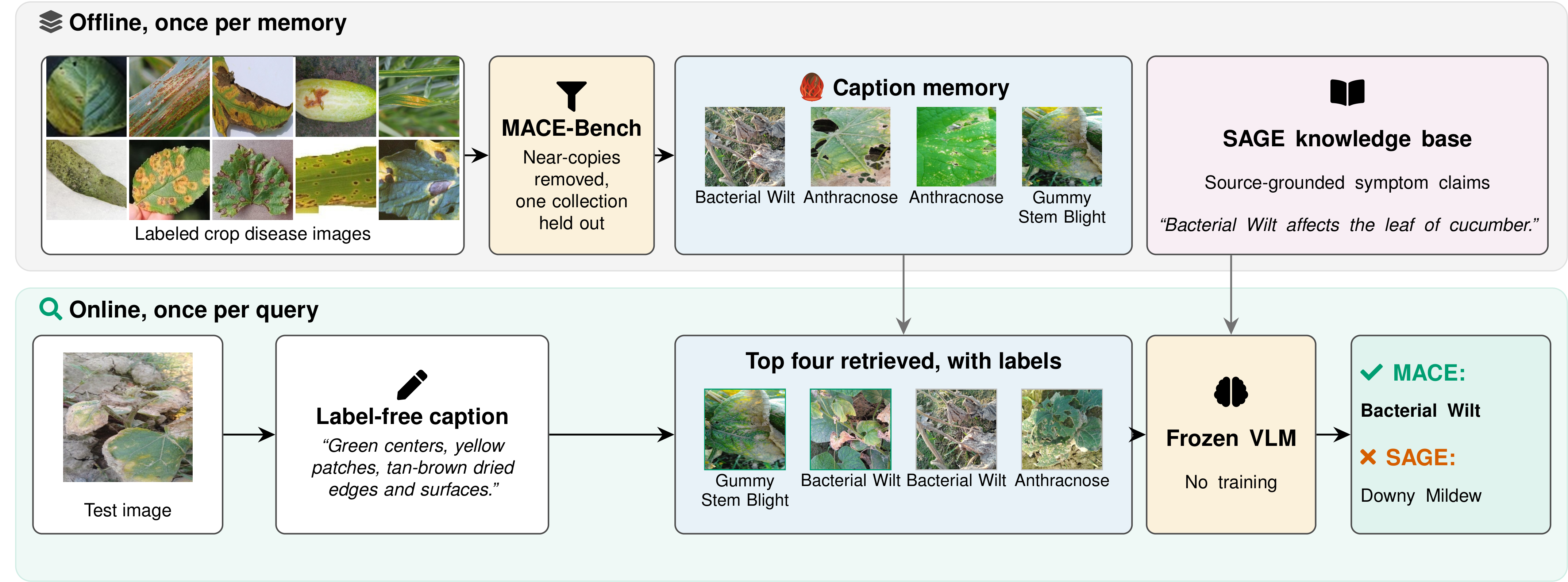
MACE describes each labeled reference image once as a label-free caption. For each test image, the four most similar captions are retrieved with their labels and added to the SAGE knowledge. The VLM is not trained.
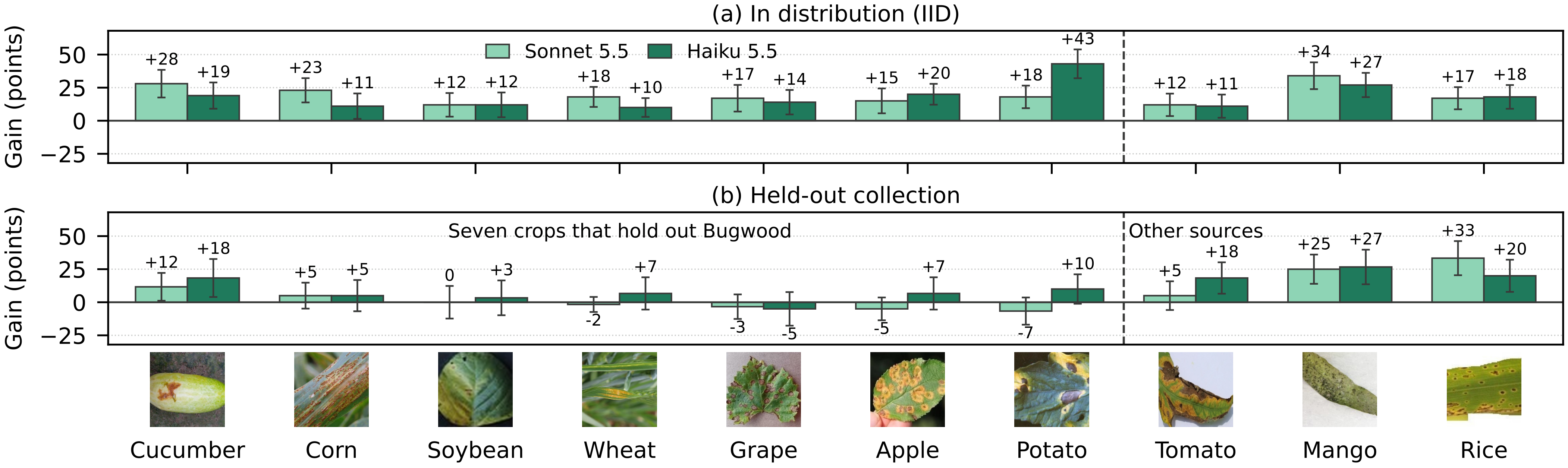
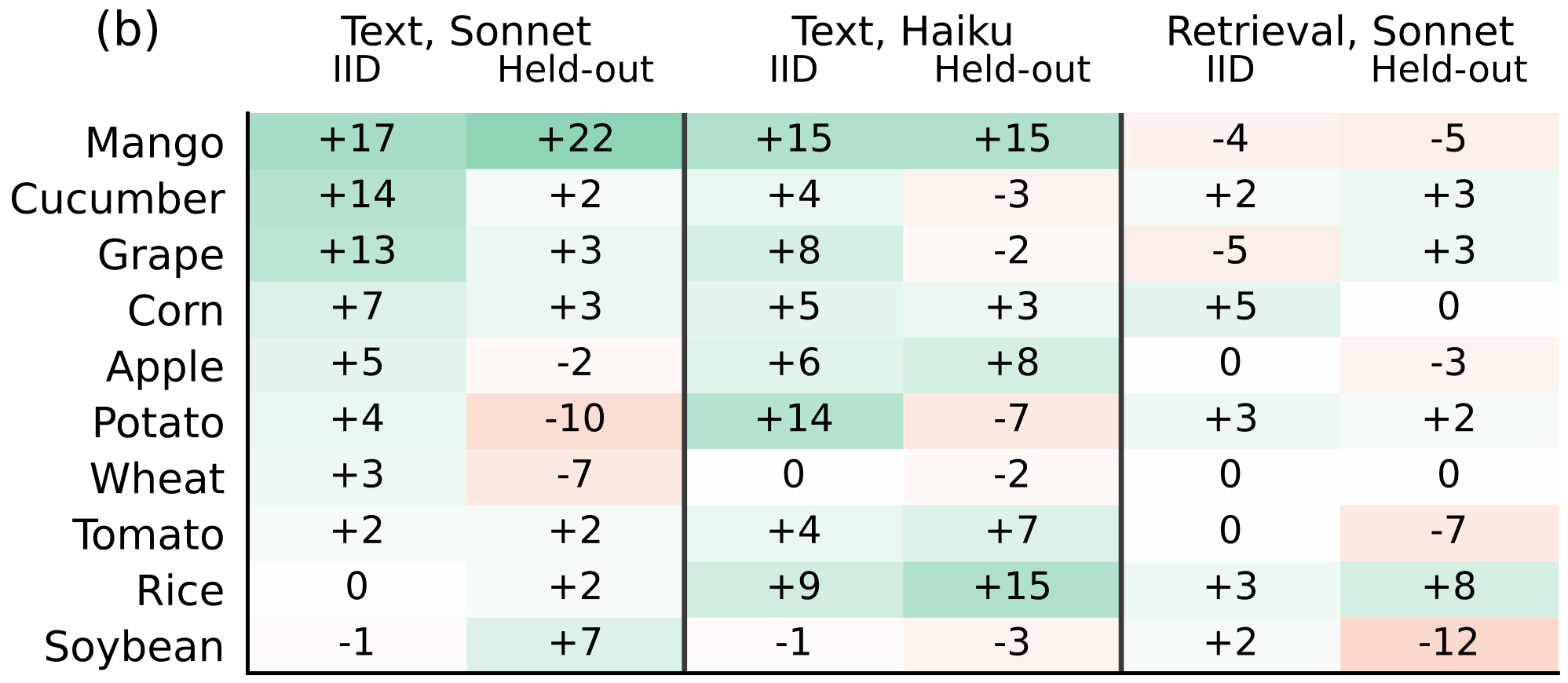
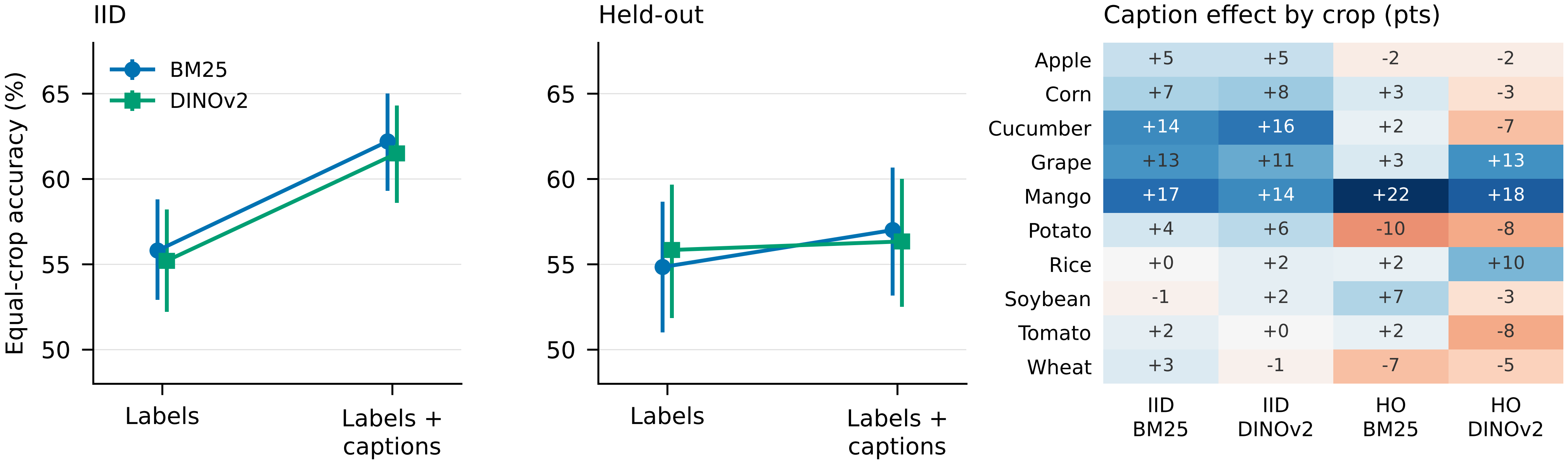
The held-out gain is smaller and varies by crop. On held-out collections, MACE is higher than SAGE on five crops, equal on one and lower on four. In a post hoc grouping, the gain is 0.0 points on the seven crops that hold out Bugwood and +21.1 on the other three, and without mango and rice it is +0.6. The same seven crops gain +18.7 in distribution, so the drop follows the source more than the crop. Haiku gains +18.5 and +11.0 overall, and +6.4 and +21.7 on the two held-out groups. Sonnet MACE is higher than DINOv2 lookup on all ten held-out collections.
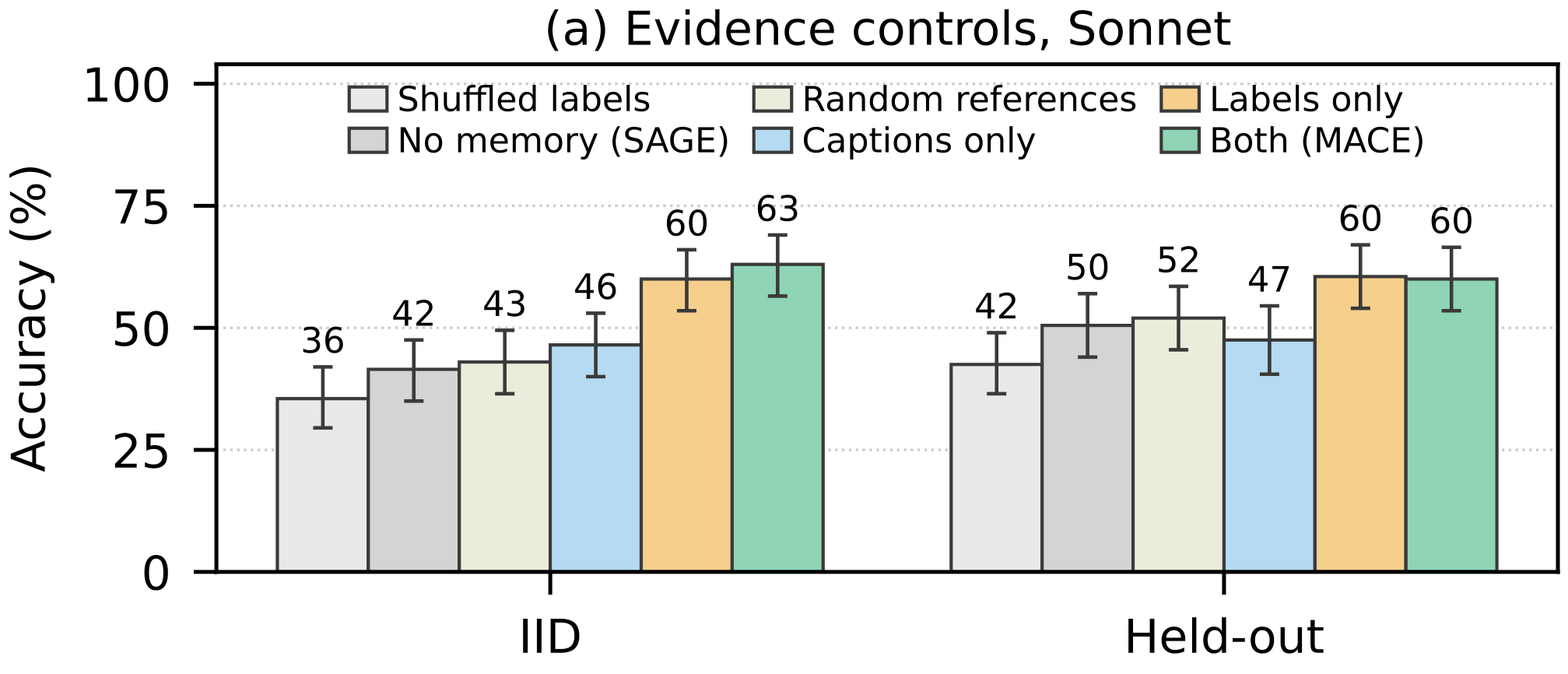
Accuracy (%) on 400 ablation queries, in distribution. On those queries, labels only did not differ from MACE. A post hoc test on all queries shows that caption text adds 6.4 points in distribution; the held-out difference is inconclusive. Captions add +6.3 points when DINOv2 selects the memory.
When the true disease is not retrieved, MACE falls below SAGE: 16.0% against 23.1% in distribution, and 24.4% against 33.1% on held-out collections.
Accuracy rises with memory size, from 53.5% to 65.5% in distribution between one and sixteen images per disease. Memory from the same collection still helps, by +5.5 points at equal bank size and disease mix; the cause is unknown.
On 200 matched queries, MACE adds 22.5 points over SAGE for $0.0014 more per query. Prices are list-price estimates in US dollars.
| Method | In distribution | Held-out | Macro, in distribution | Macro, held-out |
|---|---|---|---|---|
| No VLM call | ||||
| Label majority vote | 52.6 [49.6, 55.7] | 41.5 [37.8, 45.0] | 39.1 | 32.3 |
| Score-weighted vote | 55.7 [52.7, 58.7] | 44.5 [40.8, 48.2] | 45.0 | 35.8 |
| OpenCLIP 1-NN | 54.7 [51.7, 57.7] | 37.7 [34.0, 41.3] | 45.5 | 32.4 |
| DINOv2 1-NN | 52.5 [49.6, 55.5] | 38.2 [34.5, 42.0] | 41.6 | 32.0 |
| Frozen VLM: Sonnet 5.5 | ||||
| SAGE (KB only) | 42.8 [39.8, 46.0] | 50.7 [46.8, 54.3] | 34.0 | 40.0 |
| MACE retrieval | 62.2 [59.3, 65.0] | 57.0 [53.2, 60.7] | 51.8 | 45.6 |
| Post hoc tests, frozen VLM | ||||
| Labels only | 55.8 [52.9, 58.8] | 54.8 [51.0, 58.7] | 47.3 | 42.5 |
| DINOv2-retrieved labels | 55.2 [52.2, 58.2] | 55.8 [51.8, 59.7] | 45.2 | 44.5 |
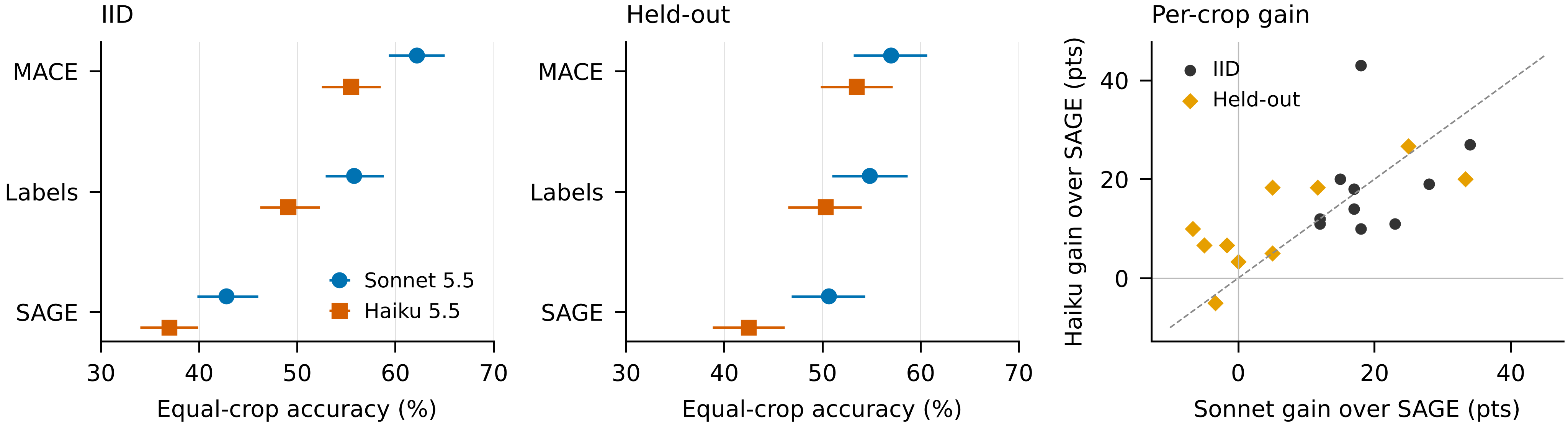
Equal-crop accuracy (%) with 95% bootstrap intervals, four memory images per disease. Macro: mean per-disease recall. Post hoc tests were added after the labels-only control was read.
| Test | In distribution | Held-out |
|---|---|---|
| Second diagnosis model: Claude Haiku 5.5, same Sonnet captions | ||
| SAGE | 37.0 [34.0, 39.9] | 42.5 [38.8, 46.2] |
| Labels only | 49.1 [46.2, 52.3] | 50.3 [46.5, 54.0] |
| MACE | 55.5 [52.5, 58.5] | 53.5 [49.8, 57.2] |
| Retrieval and evidence, Sonnet 5.5 | ||
| DINOv2 retrieval with captions | 61.5 [58.6, 64.3] | 56.3 [52.5, 60.0] |
| Fallback to SAGE at low retrieval confidence, Sonnet 5.5 | ||
| Frozen fallback rule | 61.8 [58.9, 64.6] | 57.8 [54.2, 61.5] |
| Labeled oracle (upper bound only) | 63.4 [60.5, 66.2] | 59.3 [55.5, 63.2] |
| Memory source, 554 in-distribution queries with the true disease in memory, Sonnet 5.5 | ||
| Standard memory | 60.7 [56.5, 64.9] | not run |
| Same size and disease mix | 61.2 [56.9, 65.3] | not run |
| Other collections only | 55.7 [51.6, 59.6] | not run |
Equal-crop accuracy (%) with 95% bootstrap intervals. All tests were added after the main results and are not preregistered.
Haiku MACE exceeds SAGE by +18.5 points in distribution and +11.0 held-out. It does not clearly exceed DINOv2 lookup in distribution (+3.0 [−0.8, +6.6]), although it does held-out (+15.3 [+10.5, +20.3]). Haiku tests a second diagnosis model, not an independent pipeline: it reads Sonnet captions, and both are Claude models.
Captions add +6.3 points in distribution when DINOv2 selects the memory, close to the +6.4 under BM25. Held-out caption effects are inconclusive under both retrievers.
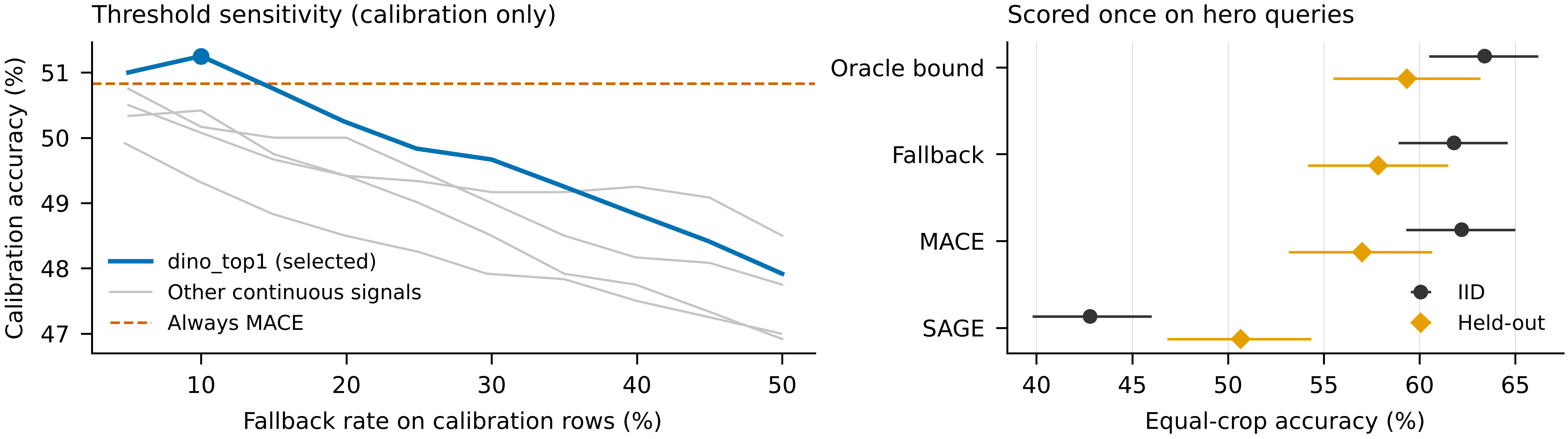
A rule frozen on 600 separate images changed accuracy by −0.4 [−1.0, +0.1] in distribution and +0.8 [−0.5, +2.2] held-out. Even an oracle would add only 1.2 and 2.3 points.
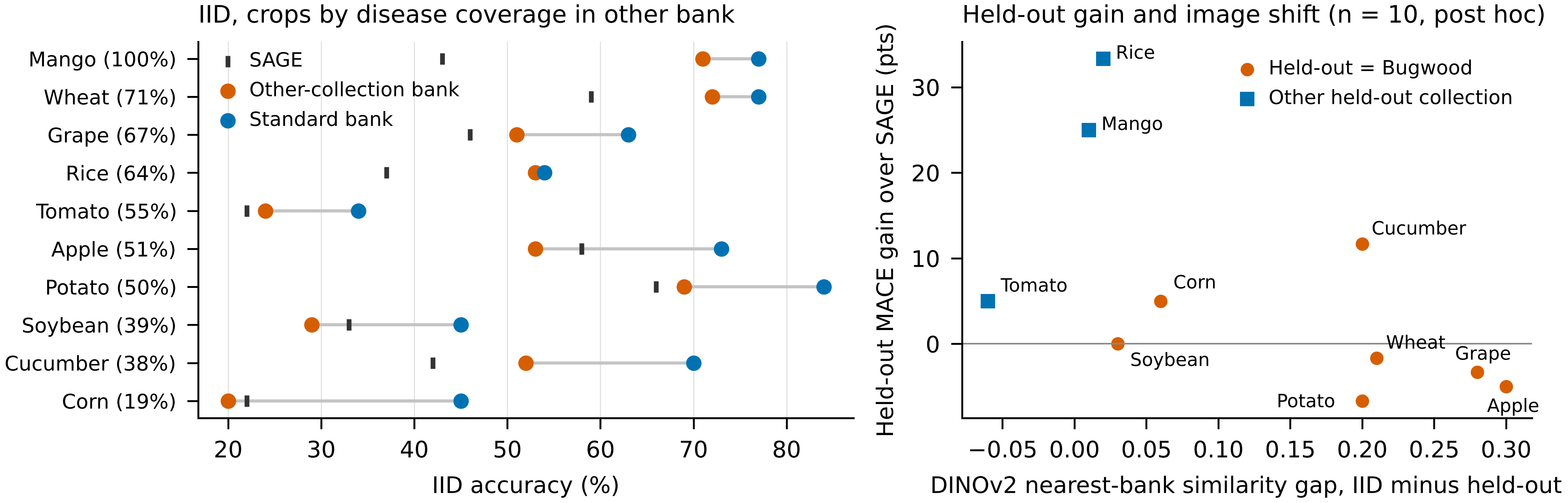
Removing same-collection images costs 12.8 points, mostly because 45% of queries lose their disease from memory. With the disease kept, a bank of equal size recovers the 5.0-point loss (+5.5 [+1.9, +9.1]). The cause is unknown: it may be a shortcut such as shared background, or closer disease appearance.
Sonnet gains 0.0 [−3.8, +3.8] on the seven crops that hold out Bugwood and +21.1 [+13.9, +27.8] on the other three. Haiku gains +6.4 [+1.7, +11.0] and +21.7 [+15.0, +28.9]. With crops as the unit, the held-out interval is [−3.2, +15.9] for Sonnet and [+4.2, +17.8] for Haiku. Seven crops share one source, so this is source-specific evidence.
Data, statistics and the full report are in results/extension.
MACE gains 24.8 and 11.8 points over SAGE on retrieval hits and loses 7.1 and 8.8 points on misses. A label-free fallback to SAGE at low retrieval confidence fired on 4.1% and 19.2% of queries and did not detectably change accuracy with either model, and even an oracle would add at most 2.3 points. It was calibrated on 600 images outside the test queries, of which 93 sit in memories that serve test queries.
Caption text added accuracy in distribution. Captions added as much after DINOv2 retrieval as after BM25, so in distribution the caption acts mainly as evidence and not as an index.

@unpublished{roy2026mace,
title = {Memory-Augmented Crop-Disease Evaluation of Frozen Vision-Language Models},
author = {Roy, Tirtho and Ganguly, Shreyan and Arshad, Muhammad Arbab and Bhattacharya, Nikhil and
Sarkar, Soumik},
note = {Manuscript in preparation},
year = {2026}
}© 2026 the MACE authors. Original text, charts, diagrams and the MACE logo are licensed under CC BY-SA 4.0. Full terms are in LICENSE.md.
Each photograph stays under the license of its source and was cropped and resized for display. The mango image may not be used commercially. Team photographs are not licensed for reuse.
To report a credit or rights concern, contact soumiks@iastate.edu. Product and model names belong to their owners.
License status as recorded on each source page, for the images shown on this page.